A lot of this was built after the children went to sleep.
I'm Abdus-Samad. I'm a doctor, I'm in the final leg of a bachelor's in Ḥanafī fiqh at WISE University in Jordan, and I teach Islamic studies in my community, from Tuḥfat al-Mulūk to al-Ṭaḥāwiyyah. Most importantly, I'm a dedicated father, willing to work relentlessly to build what my family and community need. This is my application in two parts. Part 1 is the work. Part 2 is what I think Yaqeen and I could do with it.
Counted from the git history on my laptop. The commit total also includes GP Trainer, an AI examiner for GP exam practice, which I've left out of this page to keep it about the tradition.
Four rooms, one tradition.
Yaqeen asked for two or three things I've built. I've grouped mine by the room they get used in, because that's honestly how I think about them: the same body of knowledge, carried one step further from the scholar's desk each time.
First the library, then the classroom, then the clinic. Last, the bedroom, which is where Part 2 begins.
Fiqh Revival & al-Mawsūʿah al-Ḥanafiyyah
الموسوعة الحنفية- ?The problem
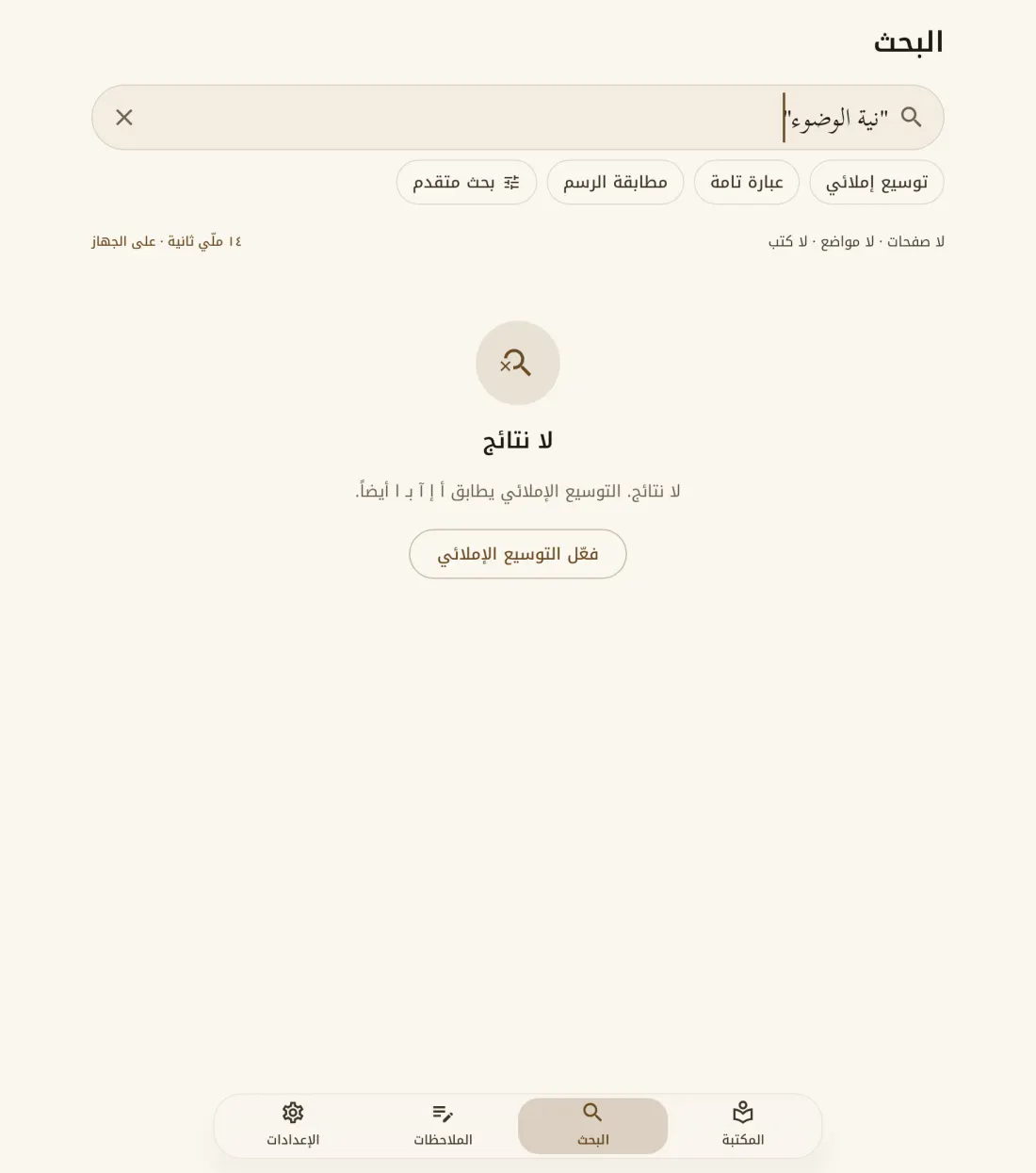
The Ḥanafī library is enormous, and most of it lives in desktop software from another era or in scanned PDFs. You can't read it properly on a phone, you can't search across the commentaries, and you can't easily see why a ruling is what it is.
- ✎What I built
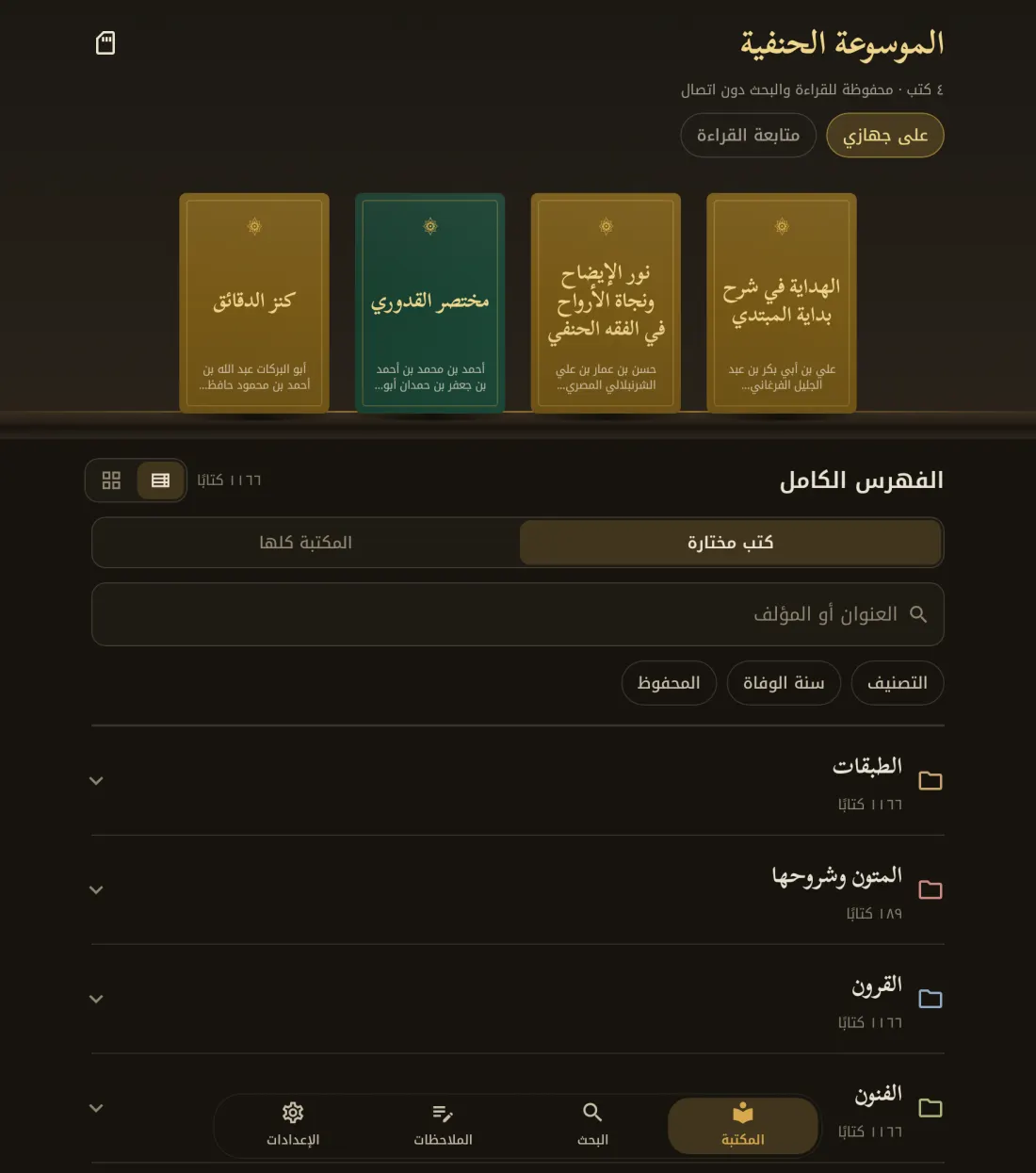
- Fiqh Revival, a reader-first library for classical texts on the web, with a native iPad app, built first around the texts I teach: Tuḥfat al-Mulūk, al-Qudūrī and al-Ṭaḥāwiyyah. Arabic first with the translation beside it, tools for teachers, and an AI study companion that retrieves from the texts and is fenced off from issuing fatwas.
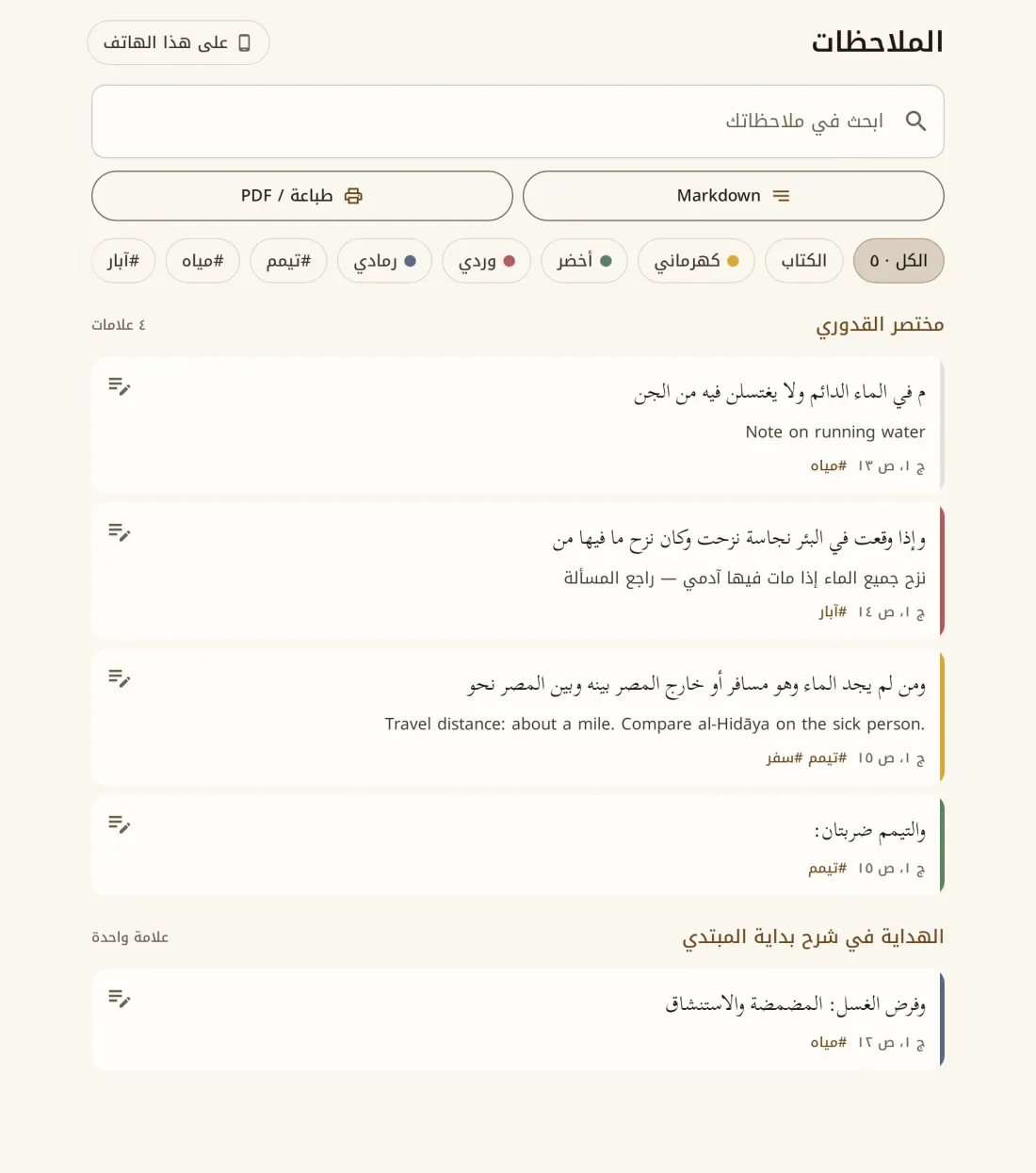
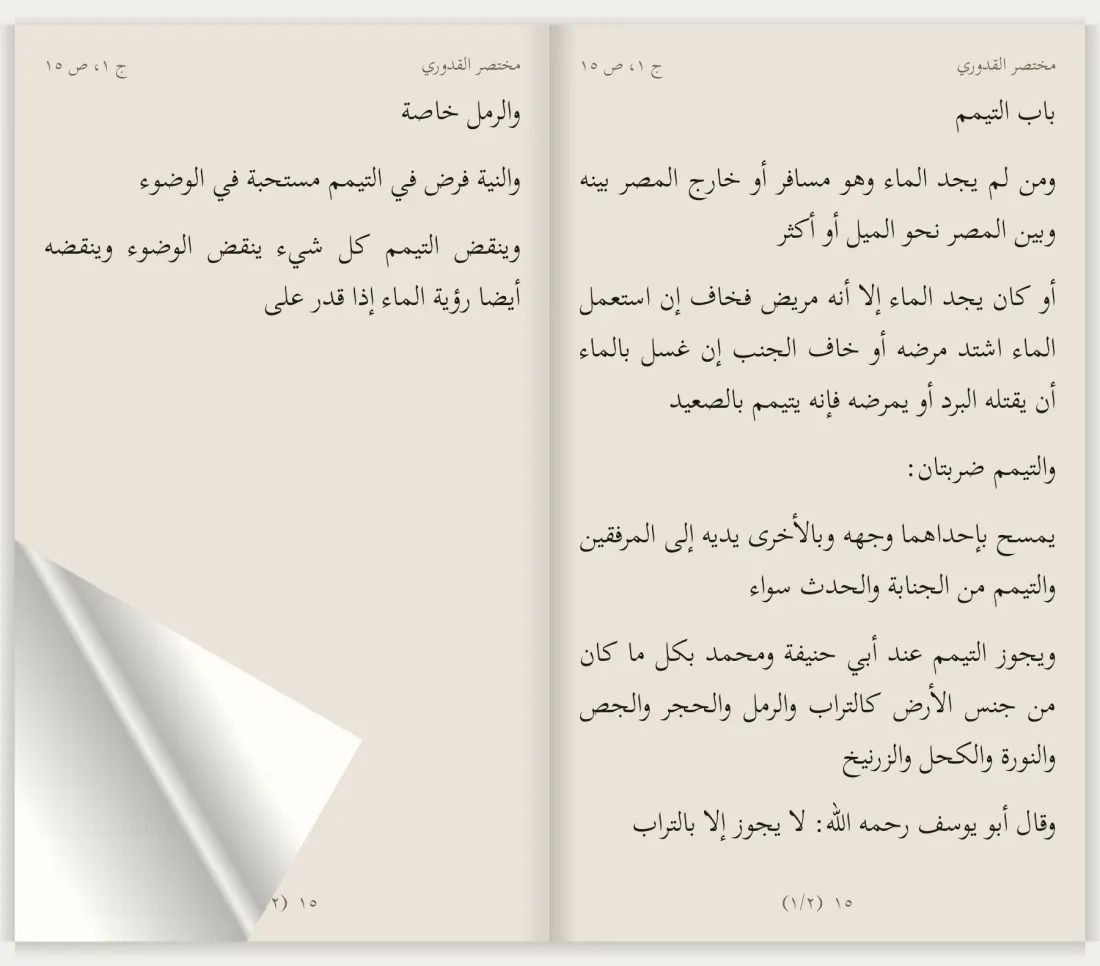
- al-Mawsūʿah al-Ḥanafiyyah for Android, an offline reader for mawsua.com: full-text Arabic search, a real page curl on foldables, highlights and voice notes, export to Markdown and PDF, read-aloud. Sixty-one commits in three days, guarded by a hundred screenshot tests.
- Maktaba Ḥanafiyya: my teacher Shaykh Ṣalāḥ's own customised build of al-Maktaba al-Shāmila, into which he had added over 1,000 books from his private collection, scanned and OCR'd. It lived on his laptop. With his permission I brought all 2,199 books out and rebuilt them for the web, with corpus-wide Arabic search that normalises spelling and diacritics, so the world can share them.
- Translation swarms for al-Ghaznawī's Sharḥ al-Ṭaḥāwiyya and for my teacher's notes on al-Qudūrī. I know where AI goes wrong and hallucinates, so the pipeline is built around it: small batches of three sections per agent, a controlled glossary, a validator that rejects any batch whose tags drift, and the Arabic always kept beside the English so every line can be checked.
- The Qudūrī graph, which pins every masʾalah to the ʿillah, maʿnā and qāʿidah behind it. Hover the diagram to walk a chain.
- ✓What changed
A scholar's private library that existed on one laptop is now open to anyone. And a student on the Tube with no signal can open Mukhtaṣar al-Qudūrī, search every commentary for مسح الرأس, and follow a ruling back to the principle that produced it.
A slide workflow for teaching al-Qudūrī
مختصر القدوري · كتاب الطهارة- ?The problem
I teach Tuḥfat al-Mulūk, al-Qudūrī and al-Ṭaḥāwiyyah in my community, through a Foundations Programme for university students and the FrontRunners Development Programme for high-school students. Building slides by hand took longer than preparing the lesson, the diagrams kept drifting into decoration, and PowerPoint kept mangling the Arabic.
- ✎What I built
- A playbook and a builder that turn a chapter exported from Fiqh Revival into a complete teaching deck, exportable to PowerPoint.
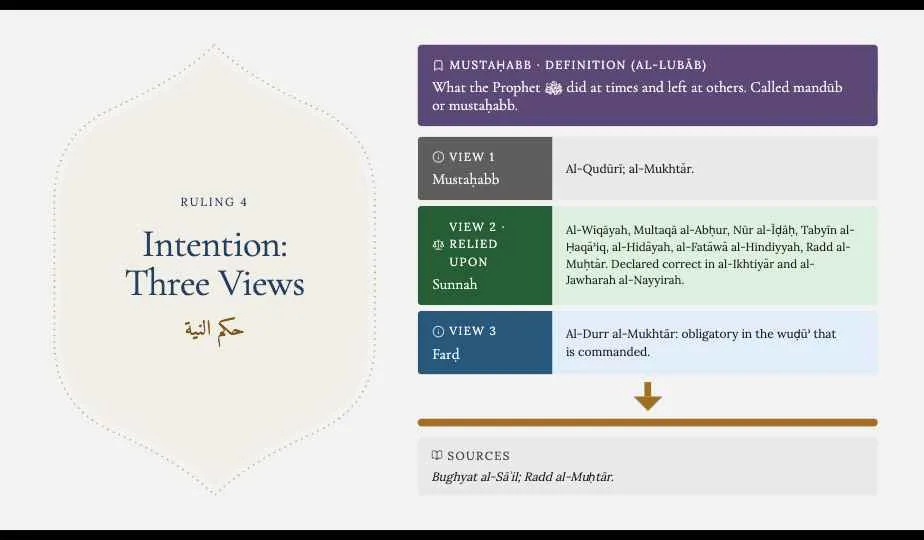
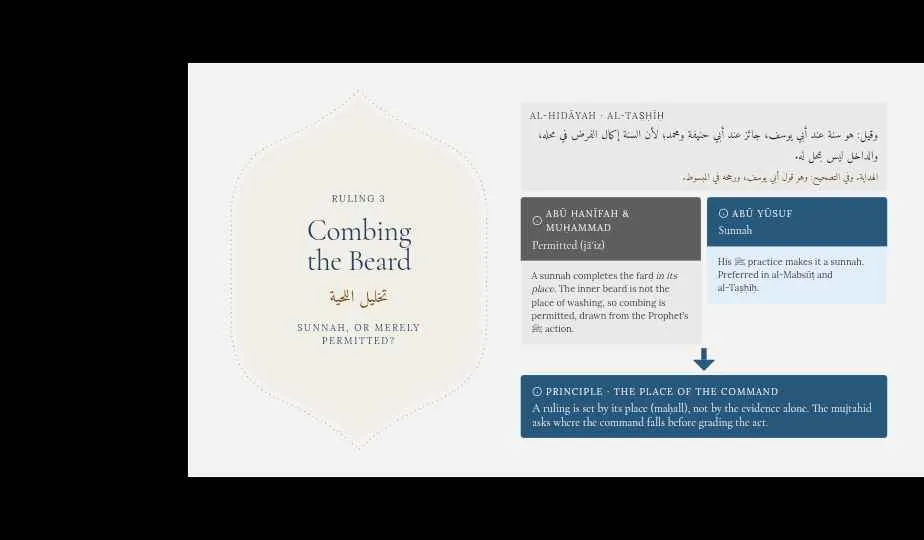
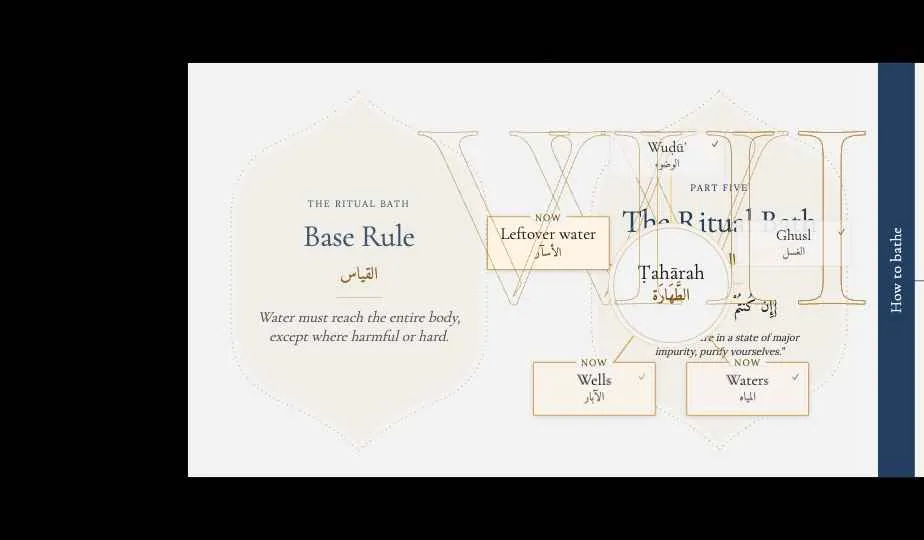
- A fixed grammar for every deck: chapter map, a dark divider for each part, the matn inside an arch with its translation beside it, then one to three commentary slides.
- The commentary slide is chosen by the shape of the argument. A qiyās with an istiḥsān exception gets an arrow from one to the other. Grades of ruling get coloured rows. A list of farāʾiḍ gets numbered cards.
- Matn, āyāt and aḥādīth always go on the slide verbatim in Arabic, with their references. Nothing is paraphrased.
- ✓What changed
Every chapter now comes out in the same visual language. My students, from university down to high school, learn the colours once, and after that they can read the structure of an argument before they've read a word of it.
A diagram must be useful and meaningful. No diagrams for the sake of diagrams.Rule 1 of the playbook
This is where my two lives meet. I practise medicine, I'm finishing a bachelor's in Ḥanafī fiqh at WISE University in Jordan, and I study under Shaykh Ṣalāḥ Abū al-Ḥājj. shifa.ac is what happens when you stop treating those as separate jobs.
- ?The problem
A patient wondering whether an MRI breaks their fast searches at midnight and lands on a forum. Doctors meet new cases with nothing reviewed to point to in English. The scholarship exists; it just isn't where anxious people look.
- ✎What I built
- A bilingual Arabic and English fatwa portal and journal for the International Medical Fiqh Institute.
- One box. Type a question in either language. A retrieval-only assistant looks for the closest published, reviewed answer. If there isn't one, the same box becomes a submission to the panel, already filled in.
- About 900 questions are in so far, each indexed whether it's answered yet or not, so the site is useful and findable before the panel has finished.
- Every answer carries the scholar who drafted it, the reviewer who signed it, the date, and its sources. A drafting and review workflow behind it. Built to run on about ten dollars a month.
- ✓What changed
Nobody hits a dead end, and nobody is ever handed a machine-written ruling.
Can I break my fast for an MRI?
Our panel hasn't answered this one yet.
Send it to them. We've already filled in your question.
Send to the panel →The AI finds. It never answers.
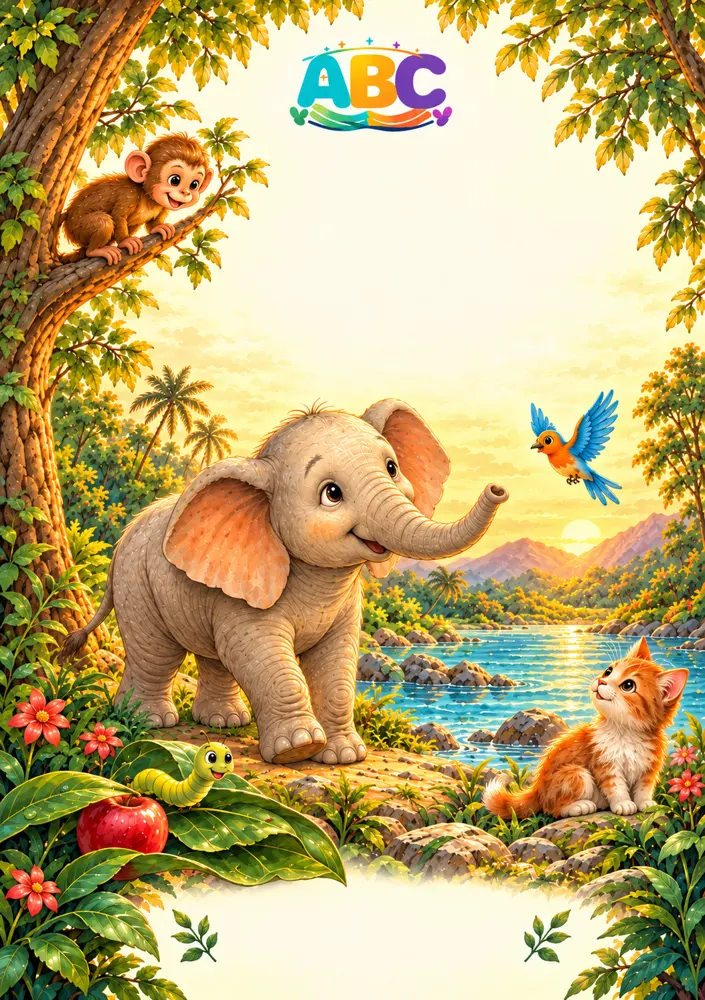
I made it for my own children. Learn Arabic like it's your ABCs. It's a library of illustrated stories in fully vowelled Arabic, graded so finely that a five-year-old can start at the bottom and, years later, pick up Qaṣaṣ al-Nabiyyīn and read it unaided. The app's real job is to make itself unnecessary.
86 stories so far, and nowhere near finished. Here are 24.
- ?The problem
Muslim children in the West mostly can't read the language of the Qur'an, and the stories they love were written by people who don't share their faith. What exists for them in Arabic is mostly worksheets.
- ✎What I built
- A native iPhone and iPad app (Swift 6, offline-first) and a web reader, sharing one backend. Twenty graded levels, tap-any-word glosses, comprehension questions, spaced review.
- A story pipeline that keeps the Arabic honest: a vocabulary ledger keyed by word sense, recycling floors at every level, and AraMorph morphology to pick the right gloss. On the first live test the naive picker glossed a word as "tongues". The ranker got it right.
- I fact-check every story myself: the Arabic, the glosses, the Qur'anic references and every Islamic detail, before a child sees it.
- Illustration to a style bible and character sheets, so Hamza looks like Hamza on every page. No faces for prophets, Ṣaḥābah or Ahl al-Bayt, checked at full size before anything ships.
- Eight games built on the child's own vocabulary, a Studio where a parent and child write their own story with AI, a print shop that posts books worldwide through Lulu, and black-and-white activity books generated from the same stories.
- ✓What changed
Two hundred families in London now read with it. Behind them: 1,774 commits across the app and the web, and a shelf that grows every week.






The same stories, off the screen
A bookstore with its own basket and checkout. Stripe takes the payment, Lulu's print API prints and posts the book anywhere in the world, and nobody ever sees a third-party storefront.
Colour, line, dots
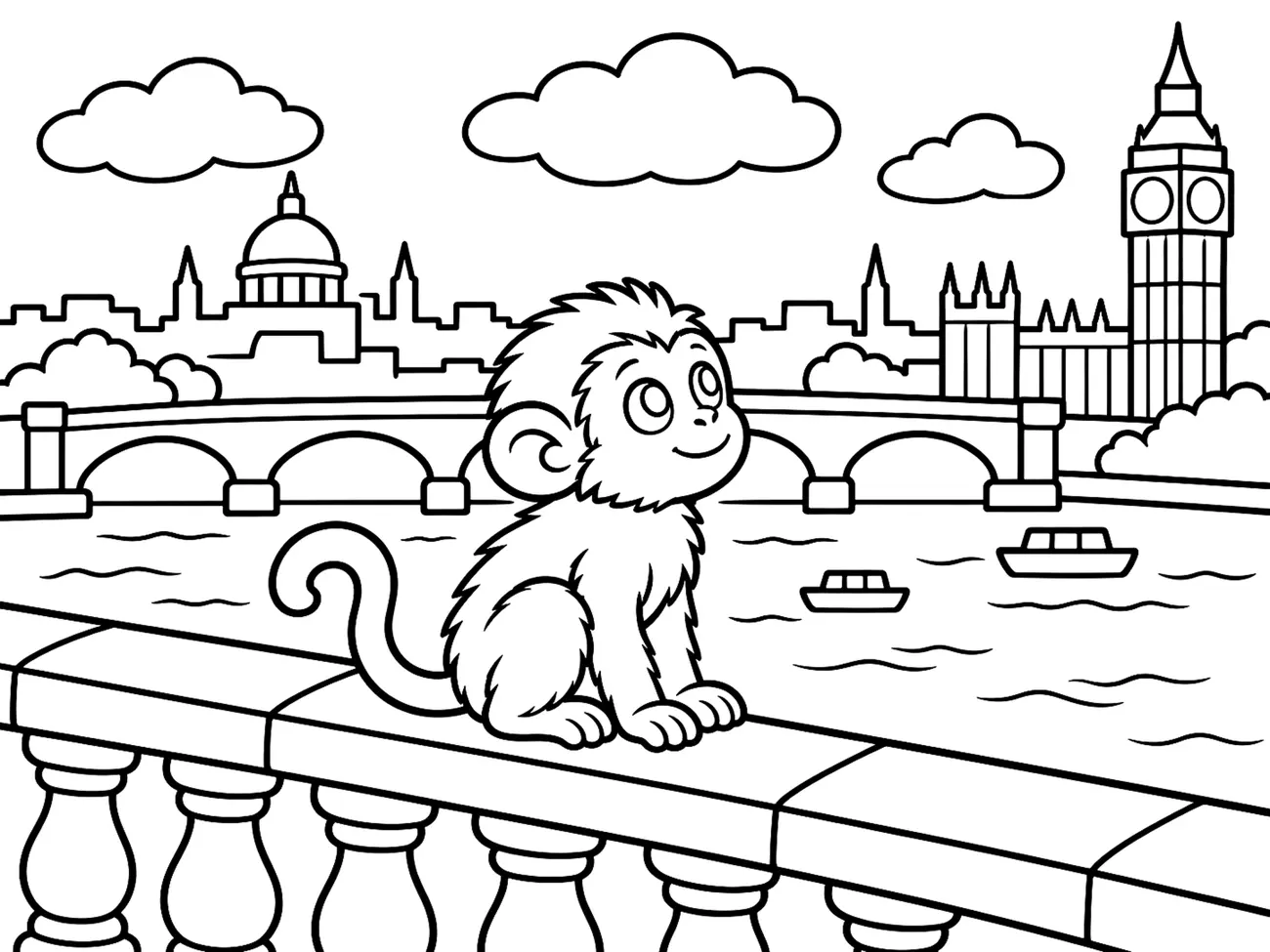
Every story can be re-drawn as line art and dot-to-dot pages, then bound into a black-and-white activity book. The editor lets me swap any drawing I don't like.
Your child's own book
A parent and child type an idea in English. It comes back as an illustrated story in Arabic, saved to the family's shelf. Anything shared beyond the family goes through human moderation first.

Teaching the library to move.
-
The problem
Children watch before they read.
An animation studio costs more than any Muslim charity I know can spend. Off-the-shelf AI video wanders off-model, invents text, and gets faces wrong, which for us isn't a style problem. It's a red line.
-
01 · Motion
Veo 3.1 animates our own art.
Every shot starts from an illustration that's already been approved. Because the first frame is our picture, Raʿd stays Raʿd. Veo never writes text and never speaks.
-
02 · Voice
The lines are read, not written.
Chirp 3 HD voices the Arabic, each character cast to the same voice the app uses. The English narration is my own cloned voice on ElevenLabs. Every Arabic word on screen is copied verbatim from the book's source file.
-
03 · Music
A cappella, checked by ear.
Lyria writes wordless beds, men's voices only. I listen to every take for instruments before it goes anywhere near a cut.
-
04 · The cut
Remotion puts it together.
Arabic pops in word by word with the English underneath, the cut is mastered to −14 LUFS for Reels and Shorts, and a budget guard reads the spend log before every single Veo call.
-
What changed$0.60per four-second shot
The Raʿd films so far took 23 takes and $15.80 of Veo time, every take logged with its prompt, model and cost. The animation is the cheap part. The engineering behind it isn't, and that bill is further down.
The smallest circle.
Conviction Circles is a lovely idea: a halaqa in a box, so any group of adults can talk about their faith properly without a scholar in the room.
There's a smaller circle than that, and it meets more often.
It meets every night. It has two members, and one of them is six.
It's bedtime. And in a lot of Muslim homes in the West, someone else is telling the story.
Conviction CirclesArabic Book Club
- Adultsa parent and a child
- Once a weekevery single night
- A kit and a facilitatora story, a voice, a lamp
A circle meets once a week. A home meets every day.
The learning app
Ten minutes of Word Worm over breakfast, using the words from last night's book. It feels like a game because it is one.
The activity book
The same story in black and white, with a dot-to-dot and a pencil. No screen, and the characters are already friends.
Animated stories
Instead of whatever autoplay picks: Raʿd, who gets his strength from remembering Allah rather than from a radioactive spider.

Bedtime stories & books
A printed book, a parent's voice, and a boy waiting for the moon. This is the circle the rest of the day is building towards.

Studio
Your child invents a story. It comes back illustrated and in Arabic, and it goes on the shelf next to the others. Pride in who you are starts with seeing yourself in a book.

Ten years ago this needed a studio. Now it needs a stubborn parent and a laptop.
Every part of what you've just scrolled through used to be its own profession: illustrator, animator, voice actor, Arabic editor, app developer, printer. AI has folded most of it into one pipeline that one person can run.
It isn't free. The last month of AI engineering alone came to about $3,000 at API list prices. But that's one person and a team of agents doing what used to take a studio, so the scarce thing now is judgement: knowing what a six-year-old will love, what a scholar will sign, and what a machine must never be allowed to do. That last part matters more than the rest put together, so I wrote it into the code.
The real bill
| Claude Code | $2,750 – $3,1109 Oct – 9 Nov · Opus 5.5, Sonnet 5.5, Fable 5.1 · 8.3 billion cached tokens read, 24.7 million written · local transcripts priced at API list rates |
| Codex | ≈ $12523 Oct – 8 Nov · GPT-6.1 · 648 million input tokens, 1.3 million output · local session logs |
| Veo 3.1 | $15.8023 takes for the Raʿd films, each logged by the budget guard |
| Whole build | ≈ $10,000Estimate: the logged month scaled by commits (3,648 in total, 1,109 in that month). Claude Code only keeps 30 days of history. |
| Actually paid | A flat Claude Max subscription, plus ChatGPT Plus for CodexAlhamdulillah. The per-token figures above are what the same work costs on the API, which is the honest number for a team to budget against at scale. |
| Not counted | Cursor, voice, images, hosting, print proofsPaid, but not in these logs |
What the machines aren't allowed to do
Conviction CirclesArabic Book Club
The circle, moved home.
Yaqeen's brief for Part 2 asks me to pick one existing Yaqeen series and one place where AI or creative technology could make it better. I picked Conviction Circles, and I'd go further than improving it: take the circle out of the meeting room and put it in the home, every night, with Arabic Book Club as the vehicle.
The children aren't in the room.
Conviction Circles gathers adults in a room once a week, with a kit. Their children aren't in that room. They're at home, and at home the stories come from somewhere else: YouTube at breakfast, Netflix after school, a library book at bedtime. Those stories are beautifully made, which is exactly the problem.
Muslim parents in the West feel it as a quiet cultural crusade being fought in their own living rooms. A weekly circle can't win that on its own. The home needs something every day, and something better to hand a child at half past seven.
Replace the circle with the home.
Arabic Book Club becomes Yaqeen's circle for families. Every theme Yaqeen researches becomes a set, scaled down to the size of a child:
No room to book and no facilitator to train. The circle meets every night, a parent leads it, and it sits on the same shelf as everything else the child already reads, plays and watches. When Yaqeen publishes on tawakkul, that week a six-year-old meets a boy who waits patiently for the moon.
The ABC pipeline, pointed at Yaqeen's research.
Nothing here needs inventing. It's the pipeline that already makes ABC, with two scholar gates added (◆).
Two signatures, and rules enforced in code.
Today I fact-check every story myself, line by line. At Yaqeen's scale that becomes two signatures. A scholar approves the one-page brief before a single image is generated. The same scholar approves the finished set before it ships. Between those two signatures the machines work inside the six rules above, enforced by validators and guards rather than a style guide someone might forget to read.
Every take is kept with its prompt, model, cost and date, so we can always show where a frame came from. That's provenance as a habit, not a feature request.
Five numbers, one of which matters most.
| Speed | Days from paper to family edition. The target is the same week as the adult kit, not the months a children's book normally takes. |
| Cost | Cost per finished set: video, voice, images and engineering, at API prices. I already log every Veo take and can price every agent run from its logs; the same ledger extends to everything else. |
| Accuracy | First-time approval rate at both scholar gates. If it drops, the brief template or the rules need work, not the scholars. |
| Reach | Families reading each Yaqeen theme the week it comes out, and how many come back the week after. |
| The one | Nights per week a child reads with a parent, straight from the reading streaks ABC already records. |
200 homes in London. Now everywhere else.
I've built the library, the films, the games, the print shop and the pipeline that feeds them, on my own, alongside medicine. It runs. What it doesn't have is what Yaqeen has: scholars who can sign every script, a name parents already trust, and a community in cities I'll never visit. Put those together and any Muslim child who wants one gets a bedtime story that makes them proud of who they are.
In that first book, a cloud covers the moon. Hamza is sad, and he waits. Then the moon comes out, and he thanks Allah for it.
A lot of Muslim homes in the West are somewhere in the middle of that story. The light is still there. Something big is in front of it.
I've spent this year building the thing that moves the cloud, seeking help in Allah. I'd like to spend the next few doing it with Yaqeen.